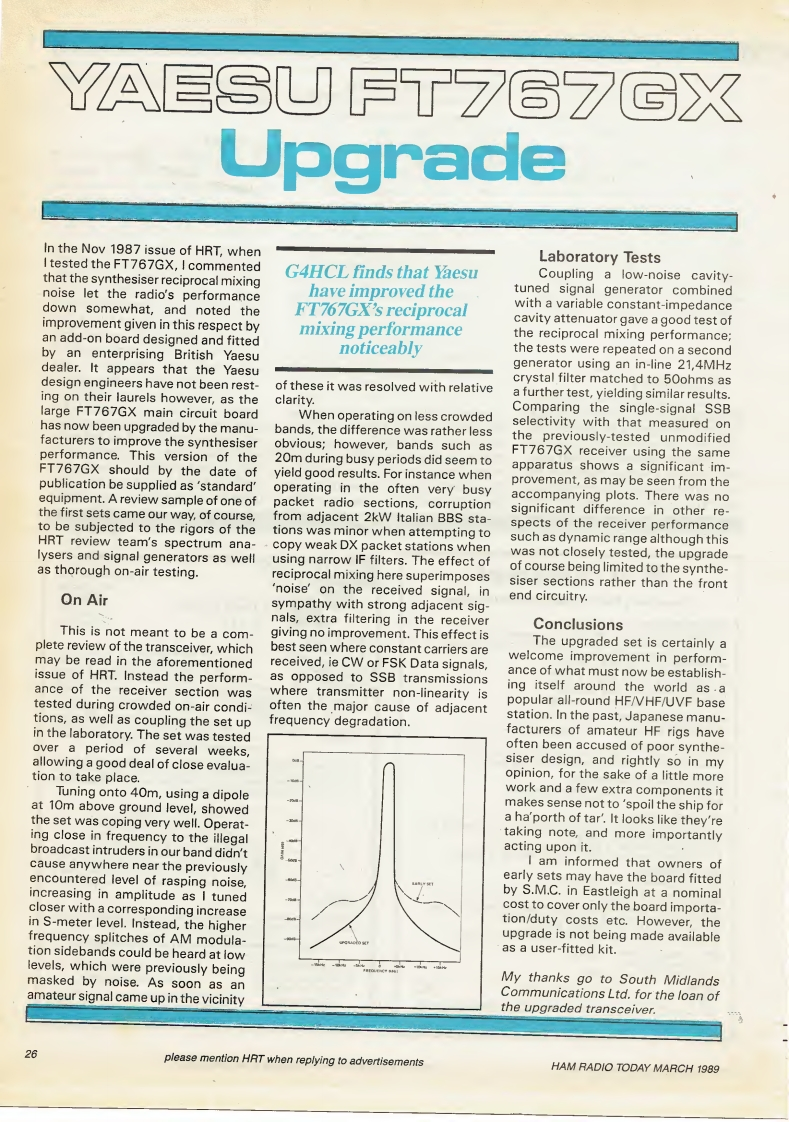
YAESUF下7G7GXUpgradeIn the Nov 1987 issue of HRT,whenI tested the FT767GX,I commentedLaboratory Teststhat the synthesiser reciprocal mixingG4HCL finds that YaesuCoupling a low-noise cavity-noise let the radio's performancehave improved thetuned signal generator combineddown somewhat,and noted theFT767GX's reciprocalwith a variable constant-impedanceimprovement given in this respect bycavity attenuator gave a good test ofan add-on board designed and fittedmixing performancethe reciprocal mixing performance;by an enterprising British Yaesunoticeablythe tests were repeated on a seconddealer.It appears that the Yaesugenerator using an in-line 21,4MHzdesign engineers have not been rest-of these it was resolved with relativecrystal filter matched to 50ohms asing on their laurels however,as theclarity.a further test,yielding similar results.large FT767GX main circuit boardWhen operating on less crowdedComparing the single-signal SSBhas now been upgraded by the manu-bands,the difference was rather lessselectivity with that measured onfacturers to improve the synthesiserobvious;however,bands such asthe previously-tested unmodifiedperformance.This version of the20m during busy periods did seem toFT767GX receiver using the sameFT767GX should by the date ofyield good results.For instance whenapparatus shows a significant im-publication be supplied as 'standard'operating in the often very busyprovement,as may be seen from theequipment.A review sample of one ofpacket radio sections,corruptionaccompanying plots.There was nothe first sets came our way,of course,from adjacent 2kW Italian BBS sta-significant difference in other re-to be subjected to the rigors of thetions was minor when attempting tospects of the receiver performanceHRT review team's spectrum ana-lysers and signal generators as wellcopy weak DX packet stations whensuch as dynamic range although thisusing narrow IF filters.The effect ofwas not closely tested,the upgradeas thorough on-air testing.reciprocal mixing here superimposesof course being limited to the synthe-siser sections rather than the frontOn Airnoise'on the received signal,insympathy with strong adjacent sig-end circuitry.nals,extra filtering in the receiverThis is not meant to be a com-giving no improvement.This effect isConclusionsplete review of the transceiver,whichbest seen where constant carriers areThe upgraded set is certainly amay be read in the aforementionedreceived,ie CW or FSK Data signals,welcome improvement in perform-issue of HRT.Instead the perform-as opposed to SSB transmissionsance of what must now be establish-ance of the receiver section waswhere transmitter non-linearity ising itself around the world as.atested during crowded on-air condi-often the major cause of adjacentpopular all-round HF/VHF/UVF basetions,as well as coupling the set upfrequency degradation.station.In the past,Japanese manu-in the laboratory.The set was testedfacturers of amateur HF rigs haveover a period of several weeks,often been accused of


请登录后查看评论内容